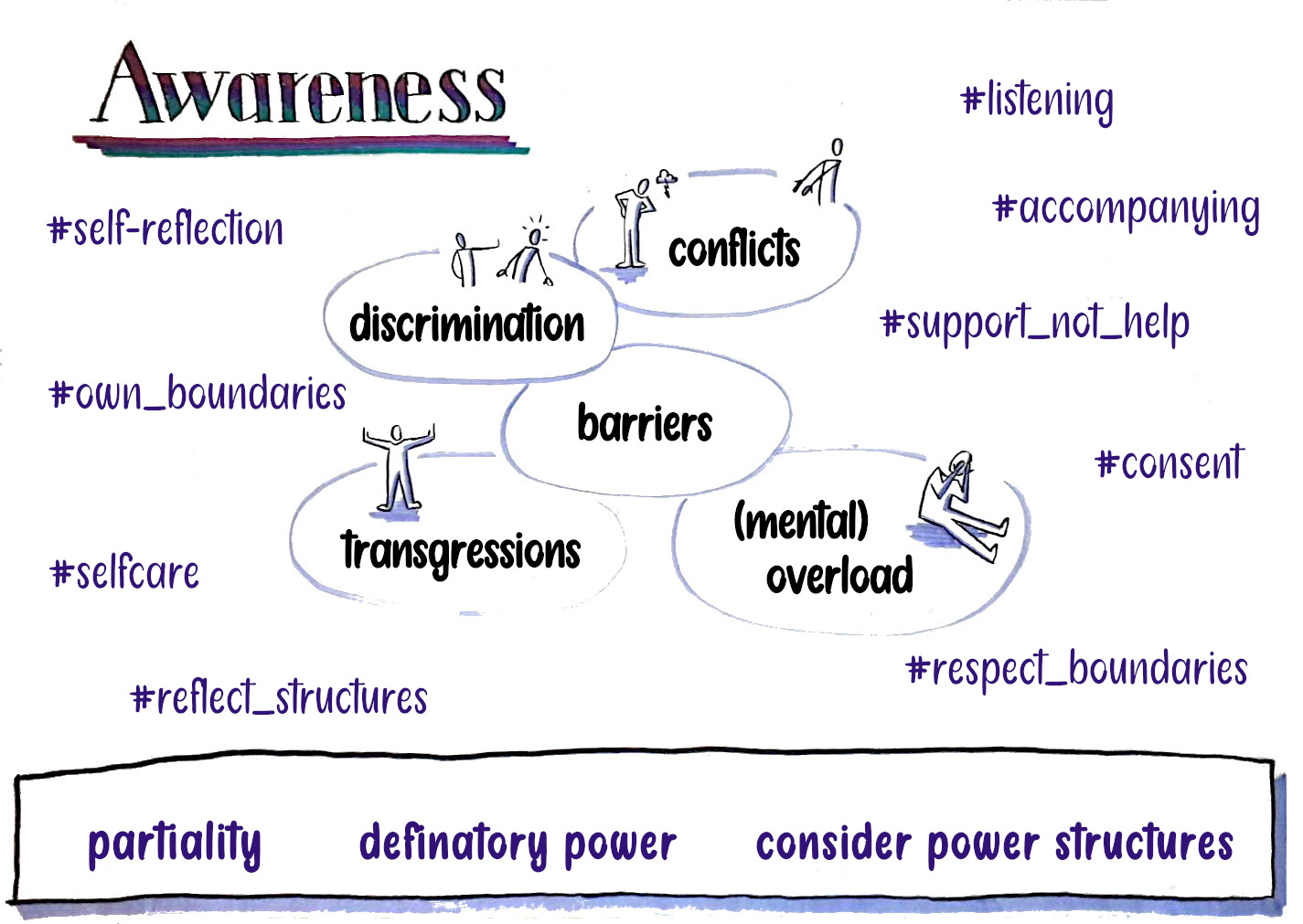
Principles Partiality # We’re on your side. What this means in practice ↕ The perspective of those affected by discrimination or harassment is the starting point of our work. We prioritise the interests and needs of those affected and support them in finding the right way to deal with a situation or their experiences. Why ↕ Against the backdrop of social power relations and structures of inequality, it is important that people are listened to without having their story being relativized. We are not looking for an objective truth. By recognizing that only those affected define whether and how their own boundaries have been transgressed, we counter experienced powerlessness and the widespread tendency towards victim blaming (blaming those affected for what they have experienced). Otherwise, the majority of society often assumes the right to decide who is discriminated against and who is not. It is important to us that people who are otherwise not heard are also recognized and taken seriously. Reflecting on Social Power Relations # We reflect on and consider situations in light of existing social power relations. What this means in practice ↕ Our society is characterized by power relations such as racism, anti-Semitism, ableism (discrimination against disabled, neurodivergent or chronically ill people), classism (discrimination against poor or socio-economically disadvantaged people), sexism, trans-, inter- and queer hostility. These power relations naturally also have an effect in our Chaos community and at events. We try to raise awareness for this and get involved in various topics. We work on these - on the inside and the outside. Why ↕ Our society is shaped by power relations. We learn these by socialisation, whether we want to or not. Internalised images, judgements and expectations influence how we see the world and interact with other people. We cannot simply discard them, but we can reflect on them and try to unlearn them. Confidentiality # What you tell us (and the fact that you are talking to us) will remain between us – unless you want something else. What this means in practice ↕ Your conversations with the awareness team are confidential. This means that we do not talk to anyone else about what you have shared with us. Or that you were talking to us at all. Unless you want us to and we make agreements. We will not try to persuade you to share anything. Every activity on our part will be discussed with you. In the team-internal handover or reflection, we speak anonymously or according to the need-to-know principle about concerns that have been brought to us. This means that each person in the team only knows as much as is absolutely necessary. Why ↕ We protect your privacy. Stressful situations require a space where you don’t have to worry about being recognised or judged later on. Only when you can trust that nothing will be shared without your consent you can truly decide freely what you want to share – and what you don’t want to share. We are aware that it takes courage to confide in strangers and share unpleasant or intimate details. We appreciate the trust you place in us. Focus on Those Affected # Your needs are our priority. What this means in practice ↕ Our focus is on the person who has experienced discrimination, harassment or sexualized violence. Our support is not based on what this means for other people. We do not judge whether you have behaved ‘correctly’ or whether what you need and want now is ‘right’. We will listen to you, possibly come up with suggestions and support you wherever we can. Why ↕ Traumatic experiences affect each person individually – therefore, it would be neither helpful nor respectful to impose our own ideas on you. We want to prevent further hurt that can arise when others question your perception or set priorities disregarding your perspective. This also allows you to regain control where it was previously taken away from you. By consistently focusing on your wishes, we create a space where you can decide for yourself what feels right, feasible and helpful. Strengthening the Ability to Act # Our aim is to enable you to act independently again. What this means in practice ↕ It is important to us to discuss everything with you when you contact us. You decide how to proceed; you know what you need. We support you in finding this out and, if necessary, assist you in implementing it. We can show you options and make suggestions, but we do not tell you what is ‘the right thing’ to do. Even the decision to do nothing or to take care of yourself first can be such a decision. We can also do things for you, but first and foremost we focus on being supportive. All of this also applies if you come to us with a different concern. Or if you want to talk to us preventively about something, for example because you want to prepare for a situation. Our focus is on the event and how you can have the best possible time there. We can consider steps and strategies for afterwards, but we can no longer accompany you then. Why ↕ Harassment, discrimination and (sexualised) violence often lead to feelings of powerlessness. Victims feel helpless, may be unsure about what they have experienced and feel paralysed. The reactions of third parties often reinforce these feelings, with comments such as ‘it’s not that bad’ or even ‘don’t be so dramatic’. Awareness support aims to create opportunities to break out of powerlessness and external control and experience self-efficacy. Reflection and Intervision # We continue to educate ourselves and reflect internally and anonymously as a team on how we have acted. What this means in practice ↕ We regularly reflect on our work and how we deal with issues and the people who turn to us. In addition, any team member can express the need for intervision. We then sit down together and discuss the specific case using a structured procedure, anonymously of course. This helps us to process the issue ourselves, but also offers the team an opportunity to learn together. Why ↕ Awareness also means that there are different possibilities and options for action in every situation – for the person who comes to us, but also for the team. Every situation is different, and no single team member has all the perspectives in mind. We want to ensure that we do not act out of habit, but consciously, responsibly and professionally. We can always make mistakes, act clumsily, accidentally hurt someone, or overlook something. We may lack knowledge or confidence in our actions. Reflection and intervision enable us to identify mistakes and gaps, to do things better next time, or to realise that we acted sensibly but there were still other options available. In this way, we sharpen our common understanding and also take care of ourselves. This contributes to our goal of offering you support that is well thought-out, reflective and professional.